summer arrives, parents begin to map out family trips. Should they head to famous mountains or cultural landmarks? Travel far or stay local? Honestly, I've often been torn over these choices. Only in recent years did I realize something key: the destinations we agonize over mean little to children.
A single journey reveals entirely different worlds through the eyes of adults and kids. After his exams, I decided to take my son on a break. Asked where he wanted to go, he wasn’t sure, so I chose Penglai and Changdao—a coastal route sans rushing. I scouted the spots in advance: Penglai’s Pavilion holds historical significance, while Changdao boasts erosion landscapes. But telling him these facts didn’t excite him. It was another set of "translations" that caught his attention.
I knew he loved noodles, so I mentioned, "In Penglai, there’s a snack stall serving bowls for just 4 yuan—super tasty." Instantly, his eyes lit up: "Affordable and delicious? That’s exactly where I want to go!" I continued, "We’ll take a ferry to Changdao—feeding seagulls on board, and there’s a huge pebble beach where you can collect pretty stones. Penglai also has sand for building castles." His whole demeanor shifted: "I want to go! I want to go! I’m ready to forget everything by the sea!"
See? In his mind, "going to Penglai" isn’t a geographic concept but a series of vivid scenes—eating noodles, feeding seagulls, collecting stones, building sandcastles.
When we arrived, it was exactly as he imagined. Seagulls gathered thickly around the ferry, swooping and diving for morsels of sausage from his hands. He fed them repeatedly, thrilled by the sense of achievement.
The moonstone beach in Yuezhai Bay shimmered with multicolored pebbles under water and sunlight. He examined each one thoughtfully, calling some like Mars, others like braised pork, and a few like little dogs.
At Jiuzhangyá in Changdao, the sunset was breathtaking—but my son was more captivated by playing stone checkers near the White Crane Lighthouse, not far from the former Bohai No. 1 navigation buoy, where he was lost in the fun.
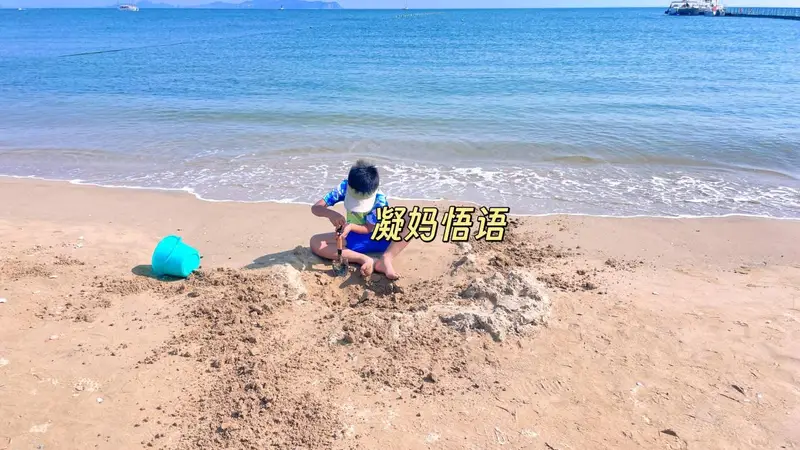
In Penglai’s beach bathhouse, the sand was fine and soft. He built sandcastles, modeled volcanoes, then gathered shells and pebbles to decorate like cakes and vaults. He stayed busy all afternoon, declaring it not enough, so I gave him another morning just for himself.
See? What we adults deem "scenery" becomes mere "props" in his eyes. He interacts with places using his own methods.
Why don’t children care where they go? Why the vast difference in perceptions between adults and kids during the same trip? The core of adult travel is "seeing." We gaze at landscapes, culture, and history, pursuing aesthetic experiences and knowledge. In our minds lies a "world map"—visiting a place is to transform a dot on it into lived reality.
A child’s travel, however, centers on "doing." They don’t care about a place’s history or architectural style; they care about—what can I do here? Can I splash in the water? Collect stones? Feed animals? Find tasty snacks? Engage in fun activities?
Psychology has a term for this: "embodied cognition"—children’s understanding of the world unfolds through interaction with their surroundings. They don’t travel with their eyes but with their entire bodies. Touch, running, manipulating, tasting—these concrete physical experiences are how they comprehend the world.
So when you ask a child, "Did you like this trip?" what they recall isn’t scenic photos but moments of total immersion. Perhaps feeding seagulls, collecting pebbles, splashing in water... These experiences matter more than "where" they went, tied to "what" they did. If children don’t care about location, does the trip still hold meaning? Absolutely!
First, by aligning with their pace, joy unfolds naturally. Many parents, like me, feel the need to visit every spot to avoid missing anything. But children’s rhythm is entirely different; they extract immense happiness from ordinary things.
At the end of the trip, my son lamented he wasn’t ready to leave, saying he’d had too much fun. When I asked what brought him the most joy, he listed many things: the cottage in their homestay that had a garden, the oddly-shaped pebbles, the stunning views at Jiuzhangyá, the Penglai Pavilion’s cannon resembling pyramids, the fun of the cable car, and the joy of playing in the sea and sand.
It turned out those things I assumed didn’t matter had stuck with him. And he’d noticed details I’d overlooked, adding them to his own happiness checklist. Why? Because when he was playing, I didn’t rush him.
When he delighted in the homestay’s garden, we explored it together; when he loved feeding seagulls, I booked premium seats on both ferries and packed enough sausage; when he reveled in sand play, we skipped planned attractions for two half-days.
These "slowing down" moments allowed him to truly absorb and process his experience—



网友评论